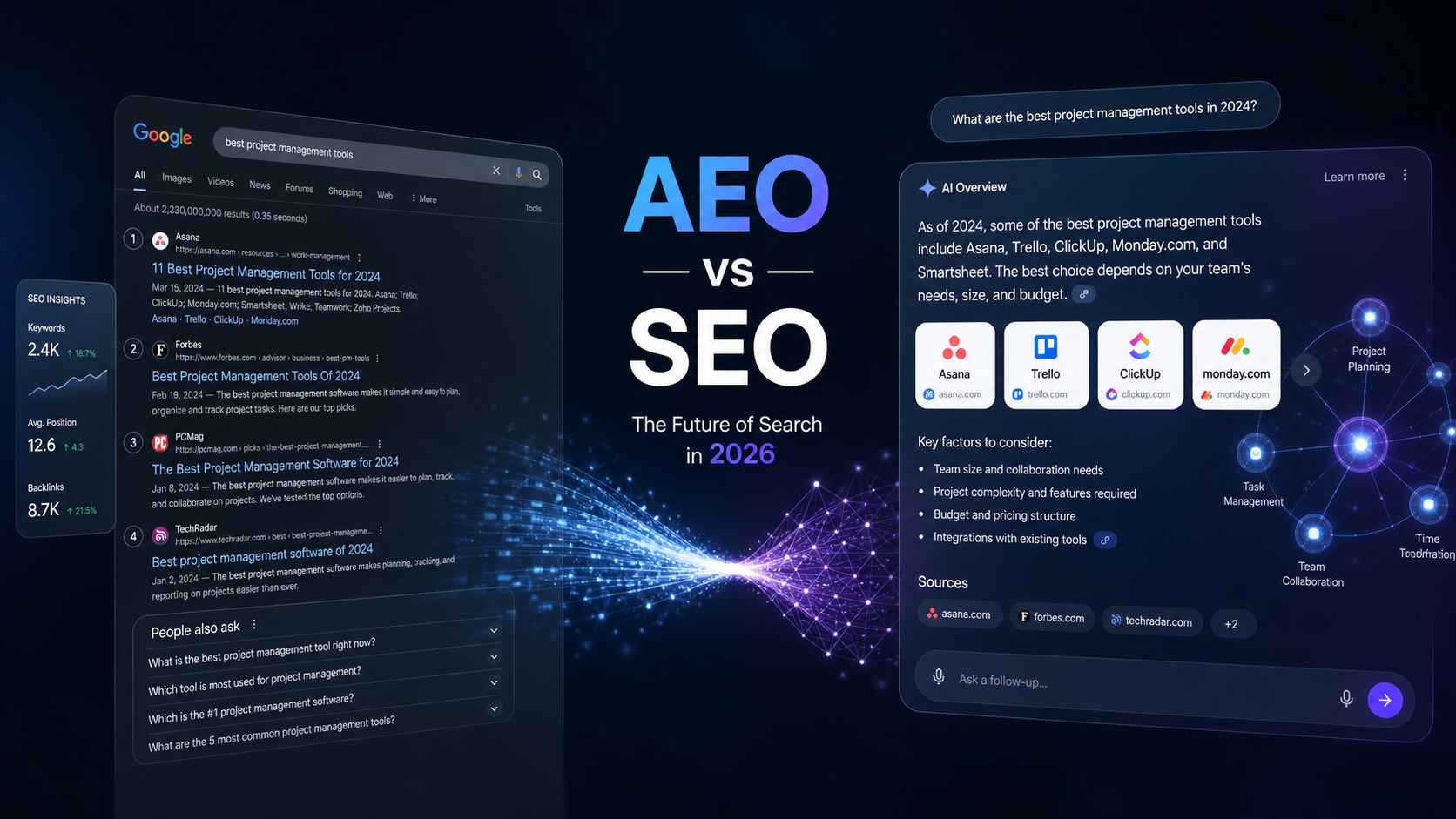
AEO vs SEO in 2026: How to Get Your Business Featured in AI Search Results
Discover how AEO and SEO work together in 2026 to boost AI search visibility, earn citations, and drive organic business growth.
By Ayush | Updated October 2026 | Reviewed by the WebmixStudio Growth Engineering Team
Search has fundamentally changed. If you are running an online business or managing brand growth, you have likely noticed that the traditional list of "ten blue links" is no longer the primary driver of organic clicks.
Today, conversational AI models and dynamic summaries sit directly at the top of the SERP (Search Engine Results Page). Users no longer just type short keywords; they ask complex multi-part questions, and platforms like Google AI Overviews, ChatGPT Search, and Perplexity answer them in plain language.
This shift has created a split in modern organic search marketing: Search Engine Optimization (SEO) versus Answer Engine Optimization (AEO).
Is traditional SEO dead? Not at all. But if your 2026 marketing roadmap only focuses on classic ranking factors, your brand risks becoming invisible in the zero-click, AI-driven search ecosystem.
In this guide, we break down what AEO is, how it differs from traditional SEO, the mechanics behind generative citations, and a step-by-step strategy to make sure your brand is the one AI engines recommend.
1. What Is Answer Engine Optimization (AEO)?
Answer Engine Optimization (AEO) is the practice of structuring, writing, and technically configuring your digital content so that artificial intelligence engines, large language models (LLMs), and semantic search bots can extract your facts and cite your brand as the direct answer to a user's prompt.
Unlike traditional SEO—which targets indexable URLs to rank in classic organic listings—AEO optimizes for synthesis and citation.
When an AI engine processes a query, it doesn't just evaluate which page has the highest domain authority. It breaks down content into entity relationships, factual claims, and contextual answers. If your content is the most direct, verified, and structured source available, the AI quotes your data, displays your brand name, and embeds your links inside the generated summary.
Classic Search (SEO):
User Query ──▶ Search Engine Algorithm ──▶ List of 10 Blue Links ──▶ User Clicks Link

AI Search (AEO):
User Prompt ──▶ Retrieval-Augmented Generation (RAG) ──▶ Multi-source Synthesis ──▶ Direct Answer with Embedded Citations
The Answer Engines You Are Optimizing For in 2026:
Google AI Overviews: Dynamic, generative snapshots displayed directly at the top of Google search results for informational, comparison, and commercial queries.
Perplexity AI: An answer-first conversational engine that displays live, verified citations alongside every paragraph of synthesized text.
ChatGPT Search: OpenAI's live-web index that pairs natural language conversation with attributed web links.
Claude & Copilot Web Integrations: Semantic assistants serving enterprise users looking for immediate vendor suggestions and data validation.
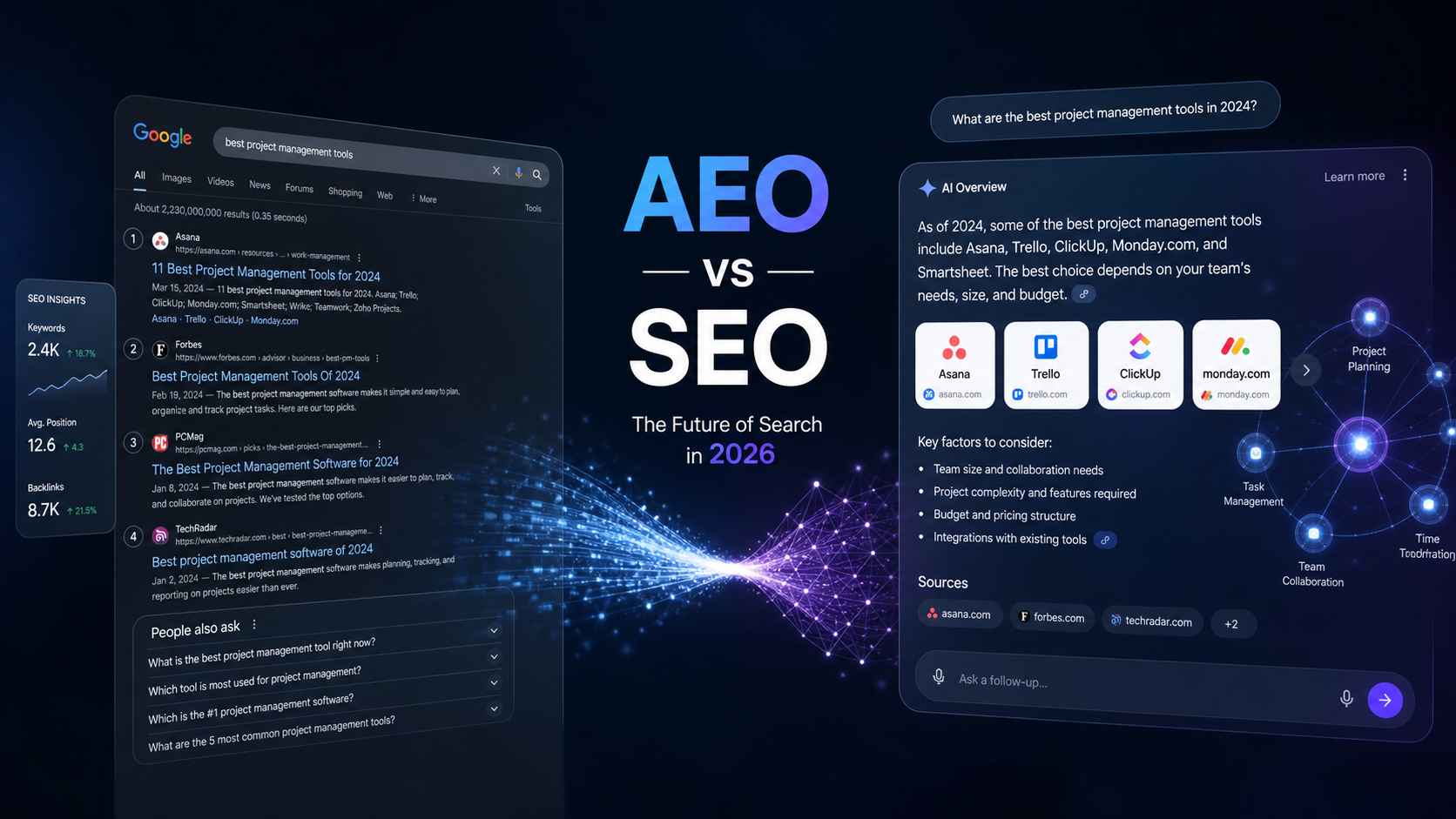
2. AEO vs SEO: The Key Differences at a Glance
A common misconception is that AEO replaces SEO. In practice, AEO is an evolution of SEO. Without sound technical architecture and topical relevance, answer engines will never trust your content enough to cite it.
Here is how the two disciplines compare across core marketing dimensions:
Dimension | Traditional SEO | Answer Engine Optimization (AEO) |
|---|---|---|
Primary Goal | Rank target URLs in positions 1–10 on search engine results pages | Earn direct mentions, entity citations, and embedded links in AI summaries |
Search Queries | Short-to-medium tail keywords (e.g., | Natural language, multi-clause prompts (e.g., “Which B2B digital marketing agency in NYC specializes in enterprise SaaS lead generation?”) |
Optimization Focus | Keyword density, metadata, backlink profiles, technical crawlability | Factual precision, information gain, Q&A formatting, schema markup, entity clarity |
Measurement Metrics | Keyword rank positions, organic sessions, bounce rate, page-level clicks | Brand share of voice in LLM responses, AI Overview impressions, citation frequency, referral traffic |
Content Structure | Long-form comprehensive guides written for linear reading | Modular blocks: TL;DR summaries, structured tables, direct definitions, clean subheaders |
Commercial Intent | Clicks to service landing pages and lead forms | Establishing your brand as the vetted solution inside the AI’s answer |
At WebmixStudio, our approach combines both disciplines. As detailed in our comprehensive SEO & Content Strategy framework, you cannot secure citations in AI Overviews if your foundation lacks technical hygiene, topical authority, and high-trust signals.
3. How AI Search Engines Select Sources (The Mechanics of AI Citations)
To get your content featured, you must understand how answer engines decide which websites to credit.
Modern answer engines rely on a process called Retrieval-Augmented Generation (RAG). When someone asks a question, the platform executes three distinct steps:
┌────────────────────────────────────────────────────────┐
│ 1. Retrieval                                           │
│ The system searches a live web index or curated vector │
│ database for documents matching the prompt's intent.   │
└──────────────────────────┬─────────────────────────────┘
                           │
                           ▼
┌────────────────────────────────────────────────────────┐
│ 2. Extraction & Fact-Verification                      │
│ The LLM parses retrieved pages, filtering out fluff,   │
│ cross-referencing claims, and identifying entities.   │
└──────────────────────────┬─────────────────────────────┘
                           │
                           ▼
┌────────────────────────────────────────────────────────┐
│ 3. Generative Synthesis & Attribution                  │
│ The model writes an original answer, inserting         │
│ hyperlinked citations to source documents.             │
└────────────────────────────────────────────────────────┘
When answer engines parse documents during Step 2, they favor content demonstrating four critical attributes:
High Information Gain: Does your article introduce fresh data, an original perspective, or a unique framework? Content that merely summarizes top-ranking competitors is discarded by generative filters as low-value noise.
Entity-Attribute Clarity: LLMs understand the world through "entities" (people, companies, places, concepts) and their attributes. Clear, declarative statements make it easy for algorithms to map your claims.
Factual Density: AI prefers concise paragraphs packed with facts, specifications, and data points over verbose introductory prose.
Platform Authority (E-E-A-T): Does the publishing domain have demonstrable experience and trust? Unverified blogs with anonymous authors are rarely selected for high-stakes medical, legal, or financial topics.
4. The 5-Pillar AEO Strategy for 2026
If you want to move from theoretical concepts to tangible organic growth, follow this systematic framework to position your brand for AI search citations:
             ┌──────────────────────────────────────────────┐
             │       5-PILLAR AEO PLAYBOOK FOR 2026         │
             └──────────────────────┬───────────────────────┘
                                    │
    ┌──────────────┬────────────────┼────────────────┬──────────────┐
    ▼              ▼                ▼                ▼              ▼
[Pillar 1]     [Pillar 2]       [Pillar 3]       [Pillar 4]     [Pillar 5]
Direct-Answer  Entity-Rich     Information Gain   Topical        Multi-Platform
Formatting     Schema Markup   & Proprietary Data Clusters       Brand Footprint
Pillar 1: Implement "Direct-Answer" Content Formatting
AI engines struggle with buried conclusions. If an article takes four paragraphs of generic background to answer a question, the model will extract the answer from a competitor who answered it in sentence one.
The Inverted Pyramid Model: Put the direct answer in the first 40–60 words of your section under an $H2$ or $H3$. Follow that answer with context, methodology, caveats, or supporting evidence.
Q&A Syntax: Frame subheaders as explicit questions (e.g., “What is the average Google Ads conversion rate in B2B?”).
Comparison Tables: AI bots scan HTML
<table>elements easily. Use tables for product comparisons, pricing breakdowns, and pros-and-cons lists.Step-by-Step Lists: For process queries, use ordered lists (
<ol>) where each step begins with an actionable verb.
Pillar 2: Deploy Entity-Rich Structured Data (Schema Markup)
Schema is the bridge between human-readable text and machine-readable data. While schema markup has been an SEO staple for years, it is mandatory for AEO.
To maximize citation likelihood:
ArticleandTechArticleSchema: Explicitly declare theauthor,publisher,datePublished, anddateModified.FAQPageSchema: Help parsers match conversational prompts to your exact pre-formulated answers.AboutandMentionsProperties: In your JSON-LD, map entities to their official Wikipedia or Wikidata URIs usingsameAsarrays.OrganizationSchema: Clearly communicate your business identity, physical office locations (such as our regional hubs for SEO in New York and SEO in Stockholm), and official service categories.
{
  "@context": "https://schema.org",
  "@type": "FAQPage",
  "mainEntity": [{
    "@type": "Question",
    "name": "What is the primary difference between AEO and SEO?",
    "acceptedAnswer": {
      "@type": "Answer",
      "text": "Traditional SEO focuses on optimizing web pages to rank in search engine results pages to drive direct clicks. AEO (Answer Engine Optimization) focuses on structuring content so AI engines can synthesize it and cite the brand as the direct source in AI Overviews and conversational responses."
    }
  }]
}
Pillar 3: Lead with Information Gain and Proprietary Data
In 2026, content written simply to hit a 2,000-word target will fail. Large language models can generate generic overviews instantly; they do not need your site to repeat definitions they already know.
To win citations:
Publish Original Benchmarks: Share aggregated, anonymous performance metrics from your real campaigns.
Document Real Case Studies: Walk readers through specific challenges, hypotheses, test setups, and quantitative outcomes.
Quote Subject Matter Experts: Include original commentary from verified practitioners.
Include Actionable Checklists: Provide proprietary frameworks that readers cannot find anywhere else.
Pillar 4: Build Cohesive Topical Clusters
Single, isolated blog posts rarely rank in competitive AI environments. Search engines evaluate your entire domain's authority across a subject area before trusting your specific answers.
Rather than publishing disconnected topics, organize your site into structured silos:
Pillar Hub: A high-level commercial or service page (e.g., our core Digital Marketing Services hub).
Sub-Service Architecture: Specialized capability pages, such as Conversion Optimization and Email Automation.
Supporting Articles: Targeted educational guides that link directly back to their parent service page and cross-reference related cluster pieces.
When you link your supporting articles logically, answer engines recognize your domain as an authoritative source on the topic. For practical examples on building early momentum, see our strategic guide on Digital Marketing for Small Businesses.
Pillar 5: Expand Your Off-Site Brand Footprint
Answer engines don't build confidence in your business purely from what you write on your own website. LLMs ingest massive cross-web training sets, forum discussions, digital PR coverage, and third-party reviews.
Third-Party Review Signals: Strong profiles on platforms like G2, Trustpilot, and Google Business Profile signal real-world customer trust.
Digital PR and Industry Publications: When industry news sources reference your methodology, AI knowledge graphs connect your brand entity to your service vertical.
Community Discussions: Answer engines frequently cite discussions on platforms like Reddit, GitHub, and industry forums to supply balanced perspectives. Ensure your leadership team actively contributes value in these spaces.
5. Connecting AEO Traffic to Real Revenue
Ranking in an AI Overview is an empty victory if it does not produce business growth. Because answer engines satisfy basic queries right in the interface, the impressions you receive will often be lower-volume but significantly higher intent.
When a user clicks a citation link inside an AI overview, they have usually bypassed introductory research. They are looking for execution, validation, or professional partnership.
AI Citation Click (High-Intent Visitor)
  │
  ├─▶ Clear Value Proposition on Landing Page
  │
  ├─▶ Contextual Bridge to Core Service Pages:
  │     • SEO & Content Strategy
  │     • Google Ads & PPC
  │     • Conversion Rate Optimization (CRO)
  │
  └─▶ Low-Friction Conversion Action (Audit, Strategy Call)
To turn AI citations into qualified sales pipeline:
Optimize Your Landing Experience: Make sure the cited page delivers on the exact premise of the AI summary. If the visitor lands on a confusing page without clear direction, they will bounce.
Integrate CRO Fundamentals: Pair informational guides with relevant, problem-solving next steps. Connect organic traffic to specialized Conversion Optimization strategies to turn readers into qualified leads.
Capture Intent via Multi-Channel Retargeting: Visitors who discover your brand through AI citations should be supported across their evaluation cycle with coordinated Google Ads & PPC campaigns and tailored Email Automation workflows.
6. How to Measure AEO Performance in 2026
Traditional rank-tracking tools that only measure whether a URL is in Position 3 or Position 7 do not tell the full story anymore.
To evaluate your Answer Engine Optimization footprint, establish these reporting workflows:
Google Search Console Search Appearance Filters: Monitor impressions and clicks generated by generative AI overviews and rich snippet features.
Brand Citation Audits: Periodically run structured prompt sets across Perplexity, ChatGPT Search, and Gemini. Track whether your brand is:
Named as a recommended vendor.
Quoted as a source of market data.
Hyperlinked in the citation box.
Referral Source Tracking in GA4: Set up custom channel groupings to isolate incoming sessions from conversational engines (e.g.,
perplexity.ai,chatgpt.com,android-app://com.google.android.googlequicksearchbox).Assisted Conversions: Monitor how frequently AI-referred visitors return via direct or branded search channels to complete contact forms and service inquiries.
Frequently Asked Questions
Will AEO replace traditional SEO?
No. AEO builds directly on top of SEO. AI answer engines rely on web crawlers, indexation, clean technical site architecture, and backlink authority to discover and evaluate content. If your website has crawl errors, slow page speeds, or poor topical structure, answer engines will not cite you.
How quickly can a website get featured in Google AI Overviews?
There is no fixed timeline. If a page already has strong organic rankings (top 1–5), authoritative backlinks, and clear E-E-A-T signals, updating the content with direct answers and structured Q&A formats can trigger AI Overview inclusion within weeks of recrawling. For newer websites, building sufficient topical authority and entity trust typically requires 3 to 6 months of focused publishing.
Does schema markup guarantee an AI Overview snippet?
No. Schema markup helps search bots parse your data accurately, but it does not guarantee inclusion. AI engines evaluate several factors simultaneously, including domain authority, content accuracy, factual consensus with other trusted sources, and overall user engagement.
Can small businesses compete with large brands in AI search?
Yes. AI engines prioritize precision and relevance over brute domain authority when answering hyper-specific, long-tail questions. A boutique agency or local business that publishes clear, firsthand case studies and detailed localized answers can easily out-cite massive publications that provide only superficial coverage.
Future-Proof Your Organic Growth with WebmixStudio
Search algorithms will continue to evolve, but one rule remains constant: systems reward clarity, real-world expertise, and genuine user value.
At WebmixStudio, we help ambitious businesses build modern organic acquisition engines that capture conventional search rankings while dominating generative AI answers. Whether you need a full-funnel Digital Marketing overhaul, technical SEO & Content Strategy, or high-performing Conversion Optimization, our team delivers measurable, revenue-driven marketing.
Ready to see where your brand stands in the new search landscape?
Book an Organic Strategy Consultation with WebmixStudio today.
About the Author
Ayush is a Digital Marketing & SEO Content Contributor at WebmixStudio. He specializes in search engine architecture, Answer Engine Optimization (AEO), and technical content modeling for high-growth service and technology businesses.
Written By

Keep Reading
More insights from the WebMixStudio team.

Digital Marketing for Small Businesses: Proven SEO and Growth Strategies That Actually Work
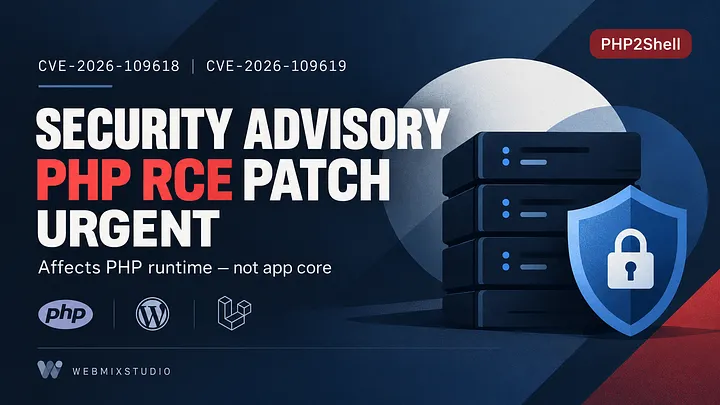
PHP2Shell: How to Patch CVE-2026-109618 and CVE-2026-109619 in PHP, WordPress and Laravel